
A clothing fanatic's morning
I wake up to my phone's alarm and lift myself with a sigh.
I wash my face and brush my teeth, look at my reflection in the mirror, and rinse my mouth, resigned to how much I've aged.
With the morning news from a radio app as background music, I grind coffee beans and slowly pour hot water.
The calmly delivered news is hard to ignore. Some people do terrible things. The bitterness awakens my brain, and I open my closet.
An omnibus of chaotic clothes spreads before my eyes. What shall I do?
While personal experiences vary, isn't this how a day typically begins?
I envisioned the daily life of an experienced clothing fanatic (which I affectionately call them here) with as much realism and detail as possible.
Clothes to choose on a sluggish morning. Days when the humidity makes coordinating an outfit a chore.
But because I'm a clothing fanatic, I have an aversion to overly ordinary styles. In short, the "ordinary" a clothing fanatic seeks isn't what's typical.
Playful Stability
Ordinary clothes for a clothing fanatic.
It's like a baseline supporting the rhythm and nuances of a day, a playful stability unique to veterans, with a precisely mechanical yet freely undulating charm.
At first glance, it seems plain, but upon closer inspection, it's not ordinary. The craftsmanship is high, and the comfort is extraordinary.
Yes, we've grown up. These are the perfect clothes for someone whose senses have been overloaded by wearing 100 times more clothes than the average person.
Clothes that somehow look put-together yet have room to breathe, feel incredibly comfortable when worn, and allow you to step out confidently anywhere.
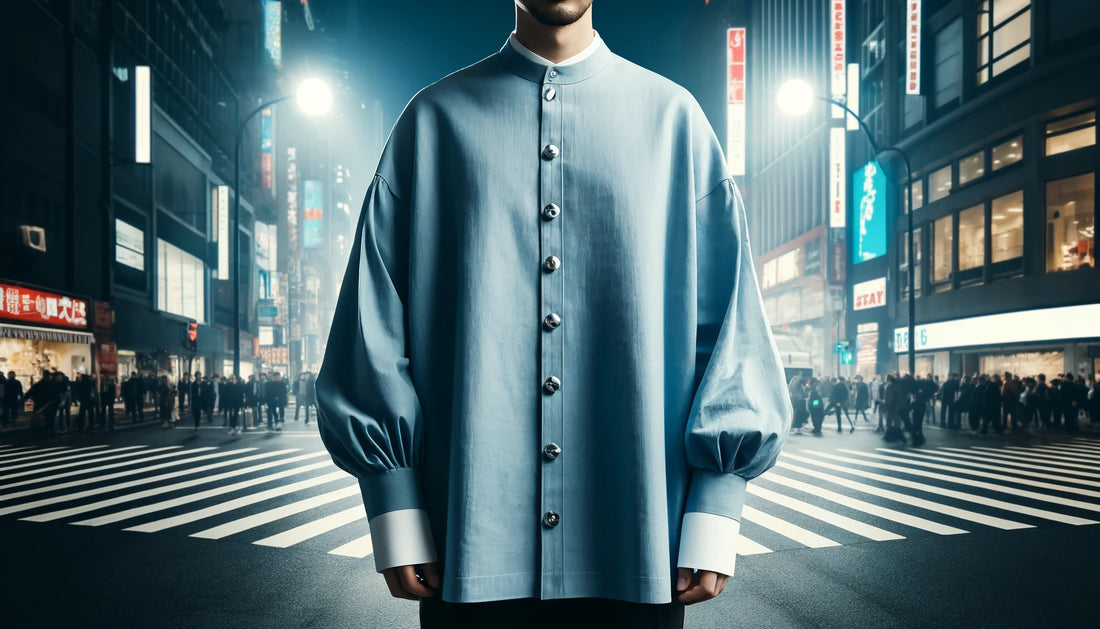
Now, let's create a device shirt that connects society with the enthusiast.
Outline
I started by roughly deciding on the design. For the collar, I unhesitatingly chose a high stand collar.
The clothing fanatic I envisioned is a free-spirited person with room for expression, so they wouldn't wear a tie.
I often start designs from the outline. The same goes for hair design, so it's a familiar process for me.
The silhouette is wide, but with areas that are cinched, carefully considering the balance.
For the hem, I aim for a sharp line where it rounds off.
Overall, it's a balance of spaciousness and tension. The chest pocket's zipper is made to be as inconspicuous as possible, and the yoke shape is cut in a way that will make those familiar with my brand smile knowingly.
A center pleat creates a gentle flow of fabric towards the hem as one walks.
The rounded corners and angle of the stand collar are just right, and a special feature of this pattern is the side gussets.
This is an important part that connects the pocket's cut line to the back panel while ensuring mobility. I encourage you to take a very close look at the actual product.

Experiment, experiment
The outline design and balance are roughly as described. I'd like to elaborate on each point, but it might be uncouth to say too much.
Next, the material. I experimented by wearing and repeatedly washing several commercially available shirts for a few days.
Ultimately, I was reminded why I disliked shirts.
First, wrinkles. They require thorough ironing.
Some people might enjoy this. Others might have a habit of dry-cleaning after each wear.
But I am neither. I want to toss it in the washing machine, hang it to dry, and wear it as is, and I want it to look presentable.
And then, the feel against the skin. When considering a shirt to wear in Japan's very humid environment, I found that less contact with the skin was more comfortable.
The material options became quite limited.
Initially, I was looking for functional materials among chambrays and broadcloths and had narrowed down candidates. However, all were rejected, and based on this experiment, it became necessary to re-evaluate based on skin feel, appearance, and function.

Body and Accessories
Among tens of thousands of fabrics across Japan, I finally found a domestically produced karsey material with six features for high-temperature and high-humidity performance.
It's cool to the touch, wrinkle-resistant, highly absorbent and quick-drying, UV-cut, pill-resistant, and has a slight stretch.
When touched, it has a crisp yet smooth feel that is comfortable against the skin.

Two types of polyester are blended with cotton, and highly twisted during spinning.
By changing the cross-sectional shape of the two types of raw cotton, it gains the characteristic of becoming soft even with high twisting.
High twisting refers to a strong twist applied to the yarn, increasing its strength.
And the buttons. Since they are placed right in the center, they are very important.
For HLVTC, accessories are essential components.
Although I usually only create black items, this time I also wanted to wear a refreshing blue shirt, so I prepared two types of buttons.
There are various types of buttons, but fast fashion and mass-produced items often use plastic materials. They are plentiful and cheap.
First, for the black shirt, I chose genuine buffalo horn buttons. The size is 15mm, quite large. As the name suggests, they are durable, lustrous, high-quality items made from processed buffalo horn.
Being natural, each one has its own unique character.
I carefully selected and gathered particularly black ones for mass production.
For the blue shirt, I adopted metal buttons. Generally, blue shirts use white buttons.
Soft fabric with gentle colors, and solid buttons.
This is nothing short of cool.


Interesting Simplicity
The sewing is done directly by a veteran seamster who runs a sewing factory with his wife in my hometown of Iwate Prefecture.
We carefully discuss details like the stitch count and how the buttons are attached.
This is a shirt that can be casually thrown on for everyday wear.
We put this much effort into creating it to achieve a playful stability.
True skill shines through in simple things. This might often be the case in other industries too.
It's like a hairdresser being asked to cut a simple yet trendy bob.
There's no room for cheap tricks.
The Bass Line presented by HLVTC.
We've created an interesting simplicity that emphasizes function and quality.
The announcement is still a little while away, but I hope you will judge it with your eyes and experience it for yourselves.
There's also a related video, so please check it out.